Parliamentary State Secretary Gitta Connemann visits Leuna chemical site: Chemical industry between massive pressure and new growth prospects
As part of her tour of small and medium-sized enterprises, Gitta Connemann, Parliamentary State Secretary at the Federal Ministry for Economic Affairs and Energy and Federal Government Commissioner for Small and Medium-Sized Enterprises, visited the Leuna chemical site today.
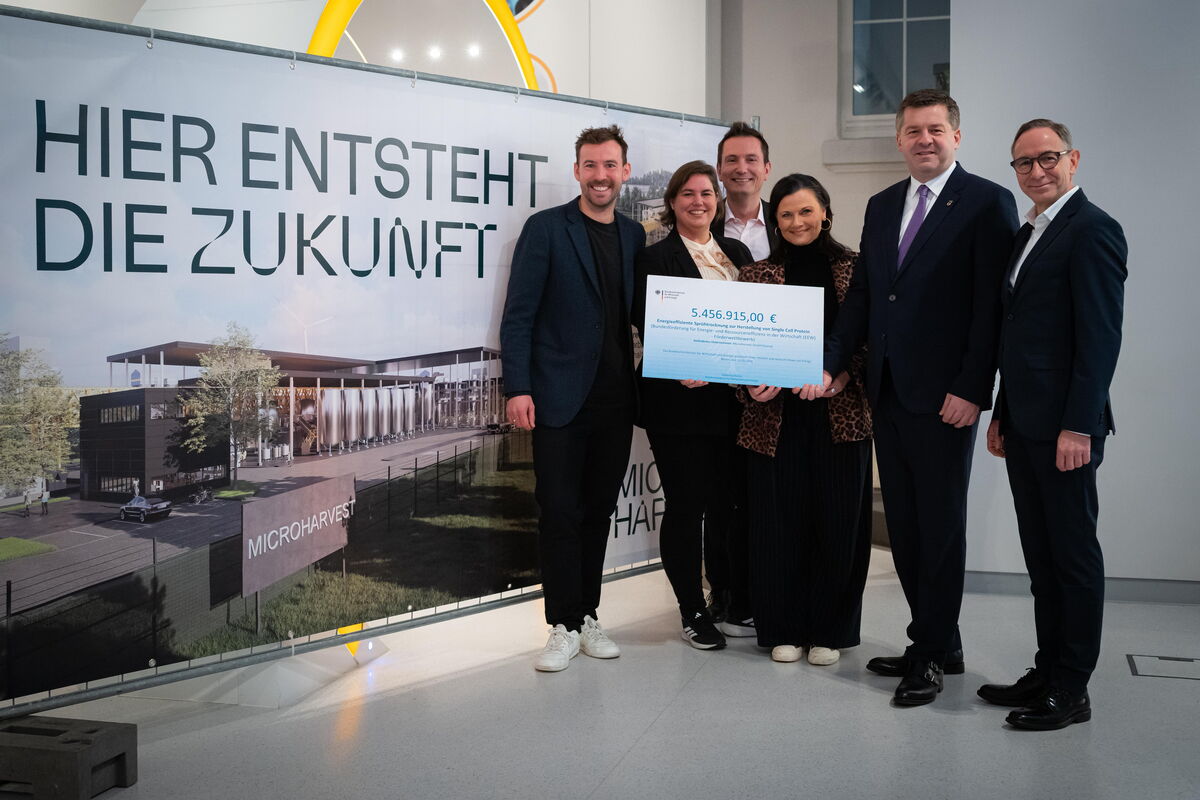
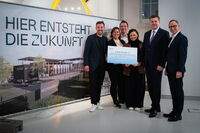
Handover of the funding approval notice to MicroHarvest at the Visitor Information Center (BIZ) at the Leuna chemical site with Jonathan Roberz, co-founder and COO of MicroHarvest, Katelijne Bekers, co-founder and CEO of MicroHarvest, Sven Czekalla, Member of the Saxony-Anhalt State Parliament, Gitta Connemann, Parliamentary State Secretary at the Federal Ministry for Economic Affairs and Energy and Federal Government Commissioner for Small and Medium-Sized Enterprises, Sven Schulze, Minister President of Saxony-Anhalt, Dr. Christof Günther, Managing Director of InfraLeuna GmbH – Image source: MicroHarvest
Accompanied by Sven Schulze, Minister President of Saxony-Anhalt, the State Secretary was welcomed at InfraLeuna by Dr. Christof Günther, Managing Director of site operator InfraLeuna GmbH, and representatives of local companies LEUNA-Harze, intelligent fluids, and biotech start-up MicroHarvest.
The visit focused on discussions with the site operator and companies based at the site on the situation of the chemical industry and the prospects for the chemical site, supplemented by a tour of the premises.
Chemical industry under massive pressure – need for political action increases The discussions made it clear that the chemical industry is under considerable economic pressure both nationwide and at the Leuna chemical site. High energy prices, especially natural gas prices, bureaucratic burdens, and international distortions of competition are weighing on existing production facilities and leading to a significant reduction in capacity utilization in some cases. The recent insolvency of DOMO Chemicals has hit the site particularly hard and underscores the urgent need for action. “The chemical industry is going through one of the toughest times in decades. We're really feeling it here in Leuna too. DOMO going bankrupt was a painful reminder of how fragile things are right now. To keep industrial value creation and jobs in Germany, we really need the federal government to take more effective action,” says Dr. Christof Günther.
Ambivalent situation at the site: growth through new plants – pressure on existing facilities At the same time, the situation at the Leuna chemical site is ambivalent: on the one hand, several large plants are currently going into operation. With UPM Biochemicals, TOPAS Advanced Polymers, and the German Aerospace Center, investments made in recent years are now taking effect and providing a noticeable growth spurt at the site. On the other hand, economic pressure on existing plants remains high. Many companies are struggling with weak demand and high costs, reflecting the overall tense situation in the chemical industry.
Signaling the future with new investment: biotech company MicroHarvest invests in the Leuna chemical site A key signal for the future from the visit is the planned new investment by biotech company MicroHarvest in the Leuna chemical site. During the visit, Parliamentary State Secretary Gitta Connemann presented the company with a grant notification for federal funding for energy and resource efficiency in industry amounting to €5.5 million. MicroHarvest plans to build an industrial-scale production facility for sustainable protein production in Leuna. The planned facility is expected to have an annual capacity of around 15,000 tons. The investment volume is in the mid double-digit million range and represents an important investment in the chemical site and the region. According to current plans, production is scheduled to start in around two years. The project will also create around 25 new jobs at the chemical site.
“Especially in this challenging phase, the establishment of MicroHarvest is a strong signal for the chemical site and the entire region. It shows that our site remains attractive despite the current pressures and attracts future investments. The combination of established chemical industry with innovative biotechnological approaches is a decisive building block for the long-term perspective here in Leuna,” explains Dr. Christof Günther.
The biotech company also emphasizes the importance of the location for the implementation of its investment project. “It was crucial for us to find a location where we could truly translate our technology into industrial reality,” says Jonathan Roberz, co-founder and COO of MicroHarvest. “We are not building a pilot project, but production infrastructure for relevant quantities. Leuna offers exactly the right environment for this: existing industry, reliable utilities, and a regional agricultural and processing network. This allows us to pick up speed and focus on what we do best—implementing scalable fermentation processes.”
Minister President Sven Schulze explained: “The establishment of MicroHarvest shows that Saxony-Anhalt, and especially the Leuna Chemical Park, continues to be attractive to investors. Here we find traditional chemical companies and young start-ups with new ideas and concepts. For both to have a bright future, the framework conditions must be right. Above all, this means lower energy costs and less bureaucracy. I hope to see further positive signals from the federal government in this regard.”
When presenting the funding approval, the Parliamentary State Secretary emphasized the importance of targeted funding instruments for industrial transformation and regional value creation. Parliamentary State Secretary Gitta Connemann: "With this funding, we are sending a clear signal: we are investing in new technologies. In the courage of founders. And specifically in energy and resource efficiency. These factors determine competitiveness—especially in our industry. We help start-ups grow—from the first prototype to industrial scaling. This creates new small and medium-sized enterprises. This is how we secure industrial value creation in Germany. 5.5 million euros is more than just money. It is also a clear commitment by the federal government to Leuna as a location. Leuna stands for industrial strength and continues to develop it. Sustainably. Responsibly. Efficiently. For us, Leuna is a location with a future."
The visit by the Parliamentary State Secretary made it clear that the Leuna chemical site is representative of the current situation in the chemical industry in Germany – caught between considerable economic pressure on existing businesses and new opportunities through investment, innovation, and new businesses setting up in the area. It will be crucial that the political framework conditions are developed rapidly in order to stabilize existing industrial structures and at the same time actively support the further development of the site.
With over 100 companies and around 15,000 jobs, the Leuna chemical site is an industrial cornerstone in eastern Germany.
Press appendix
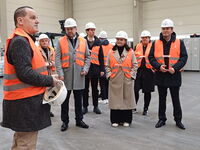
Parliamentary State Secretary visits the Leuna chemical site as part of her SME tour: Welcome address by Gitta Connemann, Parliamentary State Secretary at the Federal Ministry for Economic Affairs and Energy and Federal Government Commissioner for Small and Medium-Sized Enterprises, by Dr. Christof Günther, Managing Director of InfraLeuna GmbH, at the Leuna chemical site – Image source: InfraLeuna
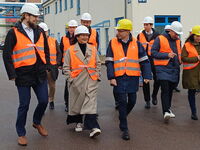
Tour of the chemical site: Gitta Connemann, Parliamentary State Secretary at the Federal Ministry for Economic Affairs and Energy and Federal Government Commissioner for Small and Medium-Sized Enterprises, with Dr. Christof Günther, Managing Director of InfraLeuna GmbH, at LEUNA-Harze – Image source: InfraLeuna
Tour of the chemical site: Sven Schulze, Minister President of Saxony-Anhalt, Gitta Connemann, Parliamentary State Secretary at the Federal Ministry for Economic Affairs and Energy and Federal Government Commissioner for Small and Medium-Sized Enterprises, Sven Czekalla, Member of the Saxony-Anhalt State Parliament at intelligent fluids – Image source: InfraLeuna
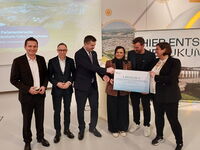
Handover of the funding approval notice to MicroHarvest at the Visitor Information Center (BIZ) at the Leuna chemical site with Jonathan Roberz, co-founder and COO of MicroHarvest, Katelijne Bekers, co-founder and CEO of MicroHarvest, Sven Czekalla, Member of the Saxony-Anhalt State Parliament, Gitta Connemann, Parliamentary State Secretary at the Federal Ministry for Economic Affairs and Energy and Federal Government Commissioner for Small and Medium-Sized Enterprises, Sven Schulze, Minister President of Saxony-Anhalt, Dr. Christof Günther, Managing Director of InfraLeuna GmbH – Image source: MicroHarvest
About MicroHarvest GmbH MicroHarvest GmbH is a biotechnology company based in Hamburg that uses microbial fermentation to produce high-quality protein from agricultural and food industry by-products within 24 hours. The process minimizes resource requirements (especially land and water consumption) and CO₂ emissions compared to conventional protein sources. MicroHarvest develops ingredients for aquaculture and pet food and is working on solutions for the human food sector. Further information about MicroHarvest is available online at microharvest.com.
About InfraLeuna GmbH The Leuna chemical site stands for dynamism, innovative strength, and maximum efficiency. Since 1990, both international corporations and medium-sized companies have invested over €9 billion in the site. Today, Leuna is one of the top locations for modern chemistry in Europe. The interdependence of materials and energy, an efficient infrastructure, and an excellent strategic location are decisive factors for the competitiveness and economic strength of the site. This is reflected not least in the more than 15,000 people and over 100 companies based there, as well as an annual production of twelve million tons of goods. InfraLeuna's comprehensive range of services includes the redundant supply of steam, electricity, fresh water, and drinking water, as well as wastewater disposal and other services. Complex logistics services are also provided. InfraLeuna is owned exclusively by local companies that operate their own plants at the chemical site. The focus is always on business success for customers and the further development of the chemical site as a whole.
Bitte geben Sie den Code ein um die geschützten Downloads freizuschalten. Nach erfolgter Eingabe werden die Downloads aktiviert und können heruntergeladen werden.